



Just What Is the Effect of Technology on the Environment?
Are we powering progress? Or putting pressure on the planet?
There’s no denying that technology is constantly changing the way we live, work and socialize. Among other things, technology brings us closer together, provides ways to stay in touch with friends, family and colleagues that might be continents apart, and gives us a wealth of knowledge at our fingertips in mere seconds.
While there are innumerable benefits to technology, the fact remains that it also affects the environment in significant ways, both good and bad. In this blog, we’re going to explore this unique catch-22 by examining the pros and cons of technology’s impact on the environment.
Key Takeaways
The 2015 Paris Agreement, signed by nearly every country on earth, reshaped global energy and technology markets. Since its signing, green technology solutions are continually flooding the marketplace.
With the advancements in technology over the years, there has also been an increase in CO₂ emissions, electricity consumption, e-waste generation and resource extraction.
There is growing evidence that the more the world continues to develop and adopt new technologies, the greater the harm there will be to the environment.
To slow the negative impact of technology on the environment, companies need to take meaningful action now.
Powering Progress: The Positive Impact of Technology on the Environment
Technology is powering the progress of things like climate action, green evolution and renewables. The 2015 Paris Agreement, signed by nearly every country on earth, reshaped global energy and technology markets. Clean technology became one of the fastest-growing global investment sectors, with global energy transition investments reaching a record of $2.3 trillion in 2025.
Since then, green technology solutions are continually flooding the marketplace, with overall green technology and sustainability market growth rates expected to exceed $185 billion USD by 2034.
Let’s dive into three ways that technology is positively impacting the environment.
3 Positive Ways Technology Impacts the Environment
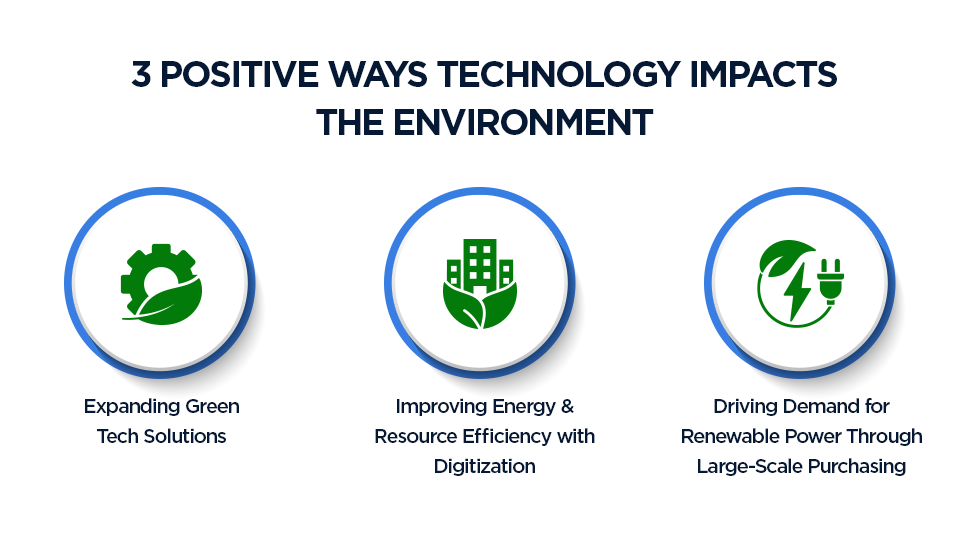
1. Green Technology Solutions Are Rapidly Expanding
From energy-efficient, smart buildings to clean transportation, green technology solutions are all around us. And the field is rapidly expanding due to economic, environmental and government policies.
As a global society, we’re under immense pressure to reduce greenhouse gas emissions to help stall the effects of global warming and climate change. These pressures have fueled technological innovation across areas such as electric transportation, energy efficiency, carbon-reduction technologies, grid modernization, low-carbon materials and scalable climate solutions.
2. Digitization Improves Energy & Resource Efficiency
When it comes to the environment, digitization may help improve energy and resource efficiency in the long run. By implementing sensors, smart meters and other data collection technologies, companies can drive real-world changes to the environment through enhanced monitoring, control and optimization.
Let’s look at three industry-specific examples to illustrate how digitization can improve resource efficiency:
Transportation and logistics companies can reduce carbon emissions by using GPS tracking to determine optimal delivery routes, cutting down on vehicle idle time.
Retailers can minimize their environmental impact by deploying printers directly to stores and using technology to remotely provision, monitor and troubleshoot them throughout their lifecycle. This reduces on-site technician visits, excess transportation and unnecessary device replacements.
Hospitals can digitize electronic health records (EHRs), reducing the amount of paper used within facilities and the physical storage needed. This indirectly contributes to energy savings across healthcare operations.
3. The Tech Sector Is a Leading Buyer of Renewable Power
As global electricity use continues to increase, coupled with intergovernmental initiatives like the Paris Agreement that put more pressure on sustainability practices, there’s a continuous demand for green and clean energy.
Despite the technology sector only consuming between 6-12% of global electricity demand in 2024, it is a leading purchaser of renewable power. In fact, Meta, Amazon, Google and Microsoft were among the top 5 global corporate buyers of clean energy in 2025. Together, the four companies accounted for 49% of global clean energy purchases, with Meta and Amazon contracting 20.4 GW of clean energy capacity.
Companies like these help speed up the shift to cleaner energy by increasing demand for and supporting the development of new clean energy projects.
Pressuring The Planet: The Negative Impact of Technology on the Environment
While green technology solutions have the potential to reduce human impact on the environment, technology also introduces significant negative effects that can’t be ignored.
3 Negative Ways Technology Impacts the Environment
1. Rising Emissions from Data Centers & AI
Advancements in technology creates an increase of emissions. In fact, a 2024 Harvard‑led study found that U.S. data centers alone produced 105 million tons of CO₂e, representing 2.18% of total U.S. emissions in 2023.
Because data centers are critical to cloud computing, e-commerce, social media, scientific research and continued AI advancement, their emissions are expected to keep rising. Unfortunately, this means that extreme weather events, rising sea levels, biodiversity loss and other environmental impacts will continue to increase as well.
2. ICT & Digital Devices Use a Large Share of Global Electricity
Rising electricity consumption within the technology sector is also harming the environment. With data centers and information and communications technology (ICT) networks currently accounting for an estimated 6% to 12% of global electricity use, continued technological advancement drives increased energy demand.
This wouldn’t necessarily be a problem if the industry were focused on using renewable energy, but the International Energy Agency (IEA) estimates that 55-60% of electricity used by data centers today comes from fossil fuels.
3. Growing E-Waste & Resource Extraction
The digital economy is a major consumer of raw resources. According to the UN Trade & Development’s 2024 Digital Economy Report, a two-kilogram computer requires 800 kilograms of raw materials, while a smartphone requires about 70 kilograms from production to disposal. When you consider that approximately 1.2 billion smartphones were shipped globally in 2023 alone, the scale of resource consumption is staggering.
As technology becomes more embedded in everyday life, demand for devices will continue to grow, further taking a toll on the environment.
So, Is Technology Good or Bad for the Environment?
In this blog, we’ve explored both positive and negative impacts of technology on the environment. Let’s summarize what we’ve discussed:
Positive Effects | Negative Effects |
|---|---|
Enables climate monitoring and data collection | Increases greenhouse gas emissions |
Supports environmental protection efforts | Requires large amounts of water |
Improves efficiency, reducing emissions in other sectors | Generates significant waste |
Drives optimization and substitution that can lower impact | Drives resource extraction and mining |
The bottom line is, there’s no denying that technology is a necessity. Society isn’t about to give up our technological advancements such as computers, printers, smartphones, televisions and more. But, if we continue along the current path unchecked, the negative environmental impacts will continue to grow, inflicting significant harm on the planet.
Conclusion: The Impact of Technology on the Environment Today
So, what can you do as a company to protect the environment?
Top 3 Ways to Make Devices More Sustainable
Be Thoughtful & Intentional with Your Procurement Decisions
One of the biggest hidden impacts of technology comes from how frequently devices are replaced. Rather than purchasing new hardware, consider investing in an enterprise device management solution that provides visibility into device health, usage and performance, allowing you to make more informed procurement decisions and avoid unnecessary hardware refreshes. After all, why replace the entire device if just the battery is at fault?Determine Ways to Extend Your Company’s Device Lifecycle
Sustainability doesn't end once a device is deployed. By proactively monitoring, diagnosing and troubleshooting issues, you can keep devices in service longer and maximize the value of existing investments. EMM enables you to resolve issues before they lead to device replacement, extending device lifecycles while reducing e‑waste and support costs.Set Digital Sustainability Policies & Educate Employees on Sustainable Tech Use
Many environmental impacts stem from smaller, everyday choices. By establishing clear digital sustainability policies and educating employees, your company can set a strong standard for sustainability stewardship and make day-to-day activities more eco-friendly.